Hunziker Areal
By
DUPLEX ARCHITEKTEN & FUTURAFROSCHMüLLER SIGRIST ARCHITEKTEN, ARCHITEKTURBüRO MIROSLAV ŠIK, POOL ARCH...
In
Zurich,
Switzerland
No collection found
Are you sure?
This will unsave the project your collection.
Compare
Compare this project with others
Details
Views:
4658
Tags
Data Info
Author
DUPLEX ARCHITEKTEN & FUTURAFROSCHMüLLER SIGRIST ARCHITEKTEN, ARCHITEKTURBüRO MIROSLAV ŠIK, POOL ARCHITEKTEN, MüLLER ILLIEN LANDSCHAFTSARCHITEKTEN
City
Zurich
Country
Switzerland
Year
2015
Program
Cooperative Housing Community
Technical Info
Site area
41000 sqm
Gfa
48035
sqm
Density
2 far
Population density
320
inh/ha
Home Units:
373
Jobs
35
Streetsroad:
0
%
Buildup:
31
%
NonBuild-up:
69 %
Residential
0 %
Business
0
%
Commercial
0
%
Civic
0
%
Description
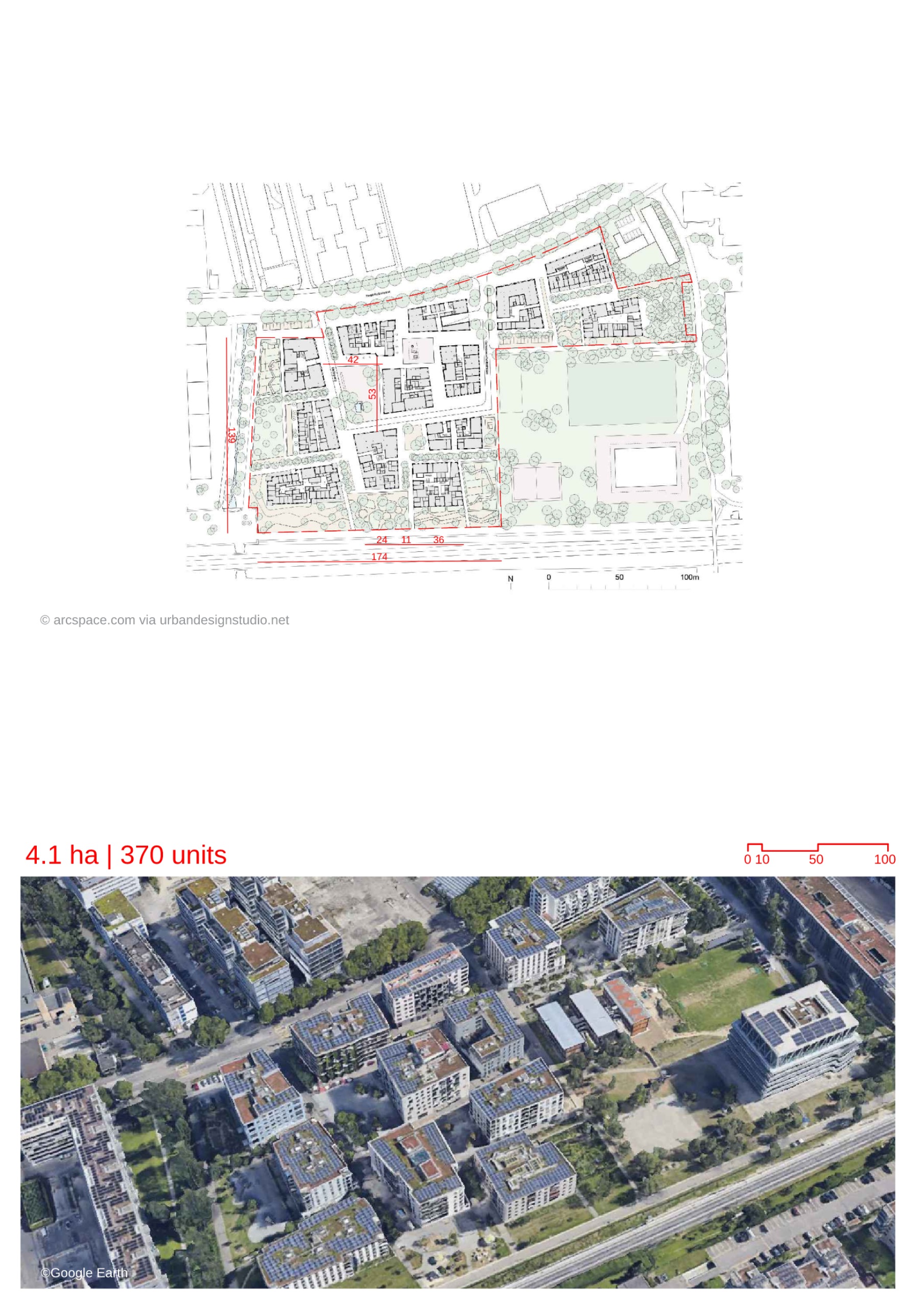
- Hunziker Areal is a sustainable housing district in Zurich, Switzerland.
- It was one of the first projects built under the “Mehr als Wohnen” cooperative society, which means “More than Living.”
- The project explores housing as more than private apartments - it also includes shared spaces, community facilities, workspaces, and everyday services.
- It contains 373 apartments.
- At the time of the press release, 1,265 people lived there.
- The land was provided by the City of Zurich through a building-rights arrangement rather than being sold.
- Even though the apartments are new, comfortable, and architecturally generous, the average living space is only 31.7 m² per person.
- This is lower than the average for other rental apartments, which is 39.1 m² per person.
- The reason is strict occupancy rules and the presence of many young families with children.
- Three quarters of households declare less than 60,000 CHF per year in taxable income.
- This is connected to the cooperative’s relatively affordable rents.
- The statement also says there are no wealth millionaires living in the cooperative.
- The cooperative provides affordable, child-friendly housing for families in the city.
- It also supports people who are disadvantaged in the housing market.
- The residents come from more than 30 countries, so the community is culturally mixed.
- Lower living space per person also supports sustainability.
- It means less embodied energy per resident.
- It also lowers infrastructure costs per person.
- Peter Schmid says that if the site had been developed as private ownership apartments, around 450 fewer people would live there.
- The City of Zurich benefits from keeping the land in public ownership and giving it through building rights.
- The city receives long-term building-right income.
- If the city had sold the land, it would have lost future control and options.
- The neighbourhood groups at Hunziker Areal are described as active beyond the development itself.
- They bring new energy and initiatives to the wider Zurich North area.
- The development was built on the site of a former cement factory.
- Instead of treating the site as a single housing estate, the masterplan transforms it into a small urban district.
- The project uses new buildings, streets, squares, and shared open spaces to turn an industrial plot into a liveable neighbourhood.
- Hunziker Areal was designed according to the idea of the 2000-watt society.
- The goal of the 2000-watt society is to reduce the energy consumption of each resident to around 2,000 watts per hour.
- For comparison, the average energy use of a typical Swiss resident is around 6,500 watts per hour.
- This means the project is not only about efficient buildings, but about designing a lifestyle with lower energy demand.
- The district includes 13 energy-efficient housing blocks.
- The buildings use low-emission construction materials.
- Many roofs include solar panels, helping the district produce renewable energy on site.
- Waste heat from a municipal data centre is reused for water heating.
- These strategies reduce the overall energy demand of the neighbourhood and support the 2000-watt target.
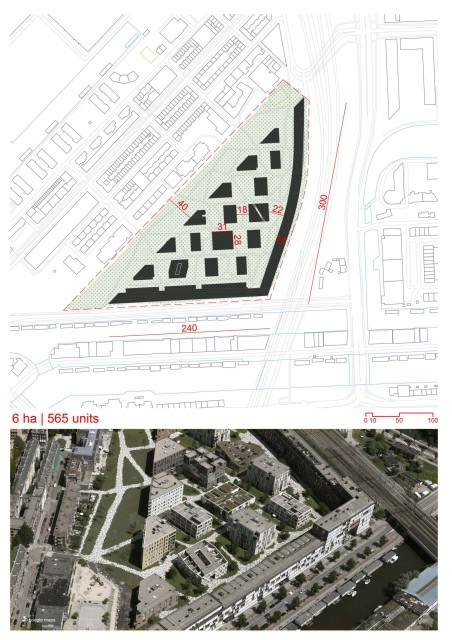
- The 13 housing blocks follow a point-block arrangement.
- Instead of one continuous perimeter block, the buildings are placed as separate volumes across the site.
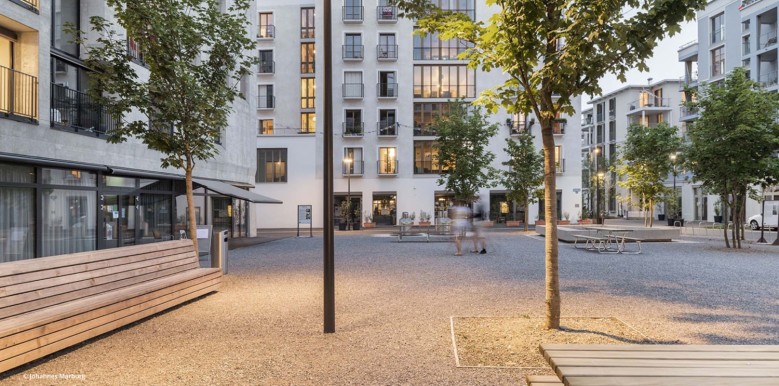
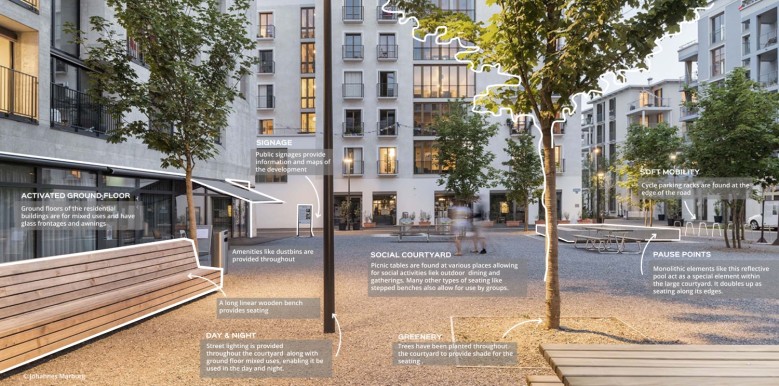
- This creates a network of spaces between the buildings - small streets, courtyards, passages, and squares.
- The layout supports walkability and gives the district a more open, porous structure.
- The 13 housing blocks were designed by five different architecture offices.
- Each building has its own architectural character.
- This gives the district visual variety and avoids the feeling of a single repetitive housing estate.
- The architectural diversity supports the idea of a mixed and collective neighbourhood.
- The development aimed to create a collective housing community.
- The masterplan provides space for everyday community activities and social interaction.
- Walkable streets, shared courtyards, and public spaces around the blocks help residents meet, move, and stay outside.
- The spaces between the buildings are as important as the buildings themselves.
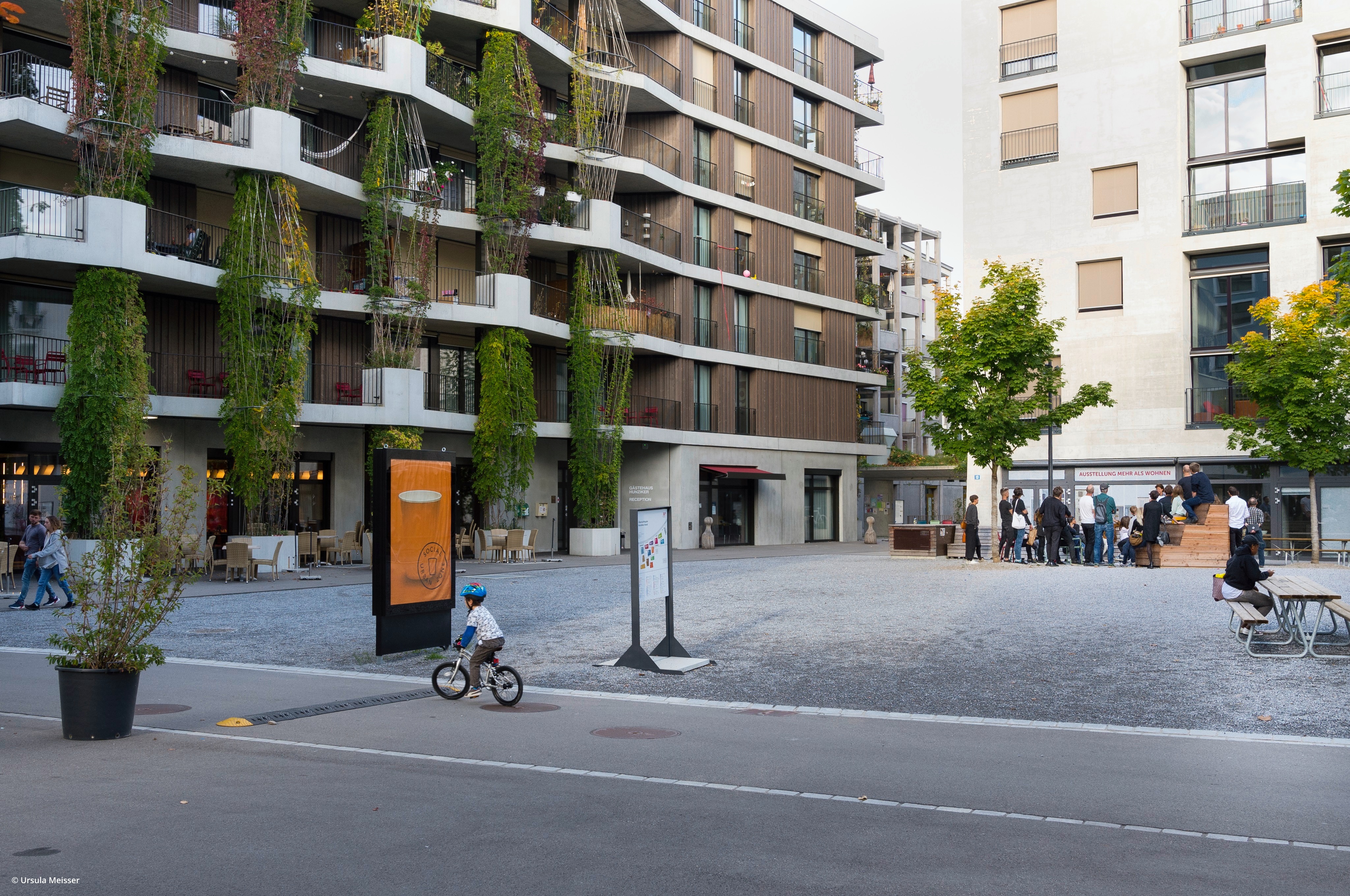
- A central public square forms the main social hub of the district.
- The buildings facing the square have different facade treatments, giving the square a stronger identity.
- Public-oriented and community uses are placed on the ground floors around the square.
- This helps the square work as an active neighbourhood centre, not just an empty open space.
- A set of shared spaces, called the “commons,” is planned throughout the district.
- These spaces were decided with local resident groups, based on their needs.
- Examples include:
- community gardens
- repair shop
- yoga room
- indoor playground
- The commons make everyday sharing part of the housing model.
- Social sustainability is addressed through diverse housing typologies.
- The project includes participatory processes, allowing residents to influence shared spaces and community life.
- Democratic membership rights in the cooperative give residents a stronger role in the development.
- The project shows sustainability as a combination of energy, architecture, governance, and everyday social life.
- The regulation translates the values of Baugenossenschaft mehr als wohnen into everyday parking rules.
- It is based on the mobility concept approved by the City of Zurich.
- The aim is to support an autoarmes Quartier - a car-light neighbourhood.
- This is directly connected to the wider vision of a 2000-watt society, where lower energy use is not only achieved through buildings, but also through mobility behaviour.
- Apartments are rented only to households that give up having a car.
- Residents must sign a declaration that they do not own/use a private car.
- Exceptions are possible only for people who can prove they need a car for health or professional reasons.
- If an exception is granted, the resident must rent and use a space in the underground garage.
- Short loading and unloading by car is allowed only for up to 30 minutes, using specially marked yellow spaces.
- Residents are not allowed to use visitor parking cards for their own cars.
- Commercial tenants and their employees can rent a limited number of paid parking spaces in the underground garage.
- They cannot use the visitor parking spaces.
- Loading and deliveries are allowed only for short periods - maximum 30 minutes - in the yellow marked spaces.
- Longer parking can lead to fines or towing.
- Occasional visitors of residents can use marked visitor parking spaces.
- They must display a visitor parking card or pay at the parking meter.
- For private events, residents can request additional temporary visitor parking cards at the reception.
- Guests staying longer than one month must rent a short-term parking space in the underground garage.
- Family members’ cars cannot be used as a loophole. If a car belongs to a relative but is mainly used by a resident, it is treated as avoiding the car-free declaration.
- Customers of shops and services can use designated customer parking spaces for short visits.
- They must display a business parking card or use the parking meter.
- Restaurants and shops with higher visitor traffic can have specific customer parking spaces assigned to them.
- These spaces have to be rented and clearly signed.
- The business tenant is responsible for controlling the parking use.
- Residents with scooters or motorcycles must rent spaces in the underground garage.
- Visitors and customers can park motorcycles and scooters only in designated areas.
- Wrong parking can lead to fines or towing.
- Bicycle parking is provided in the buildings and across the site.
- Bicycles left for more than one week outside designated areas can be removed by the cooperative.
- Unused or abandoned bicycles are cleared once or twice per year.
- Before removal, they are marked for four weeks and residents are informed.
- The cooperative reserves the right to introduce bicycle identification and to limit the number of free bicycle spaces per resident.
- The parking strategy is part of the urban design, not just management.
- The district reduces private car ownership through tenancy rules.
- Parking is concentrated and controlled, rather than spread across the public realm.
- Ground-level space can therefore be used for streets, squares, community life, gardens, walking, cycling, deliveries, and short visits.
- The regulation protects the idea of Hunziker Areal as a walkable, social, low-energy neighbourhoo
Sustainable Housing District
Living space per person
Household income
Social role
Sustainability argument
Public land argument
Neighbourhood impact
Hunziker Areal shows sustainability as a social and spatial model: less living space per person, affordable rents, diverse residents, shared governance, and a lower-energy way of urban living.
From Industrial Site to Urban Neighbourhood
2000-Watt Society Concept
Energy and Environmental Strategies
Urban Form and Block Arrangement
Architectural Diversity
Collective Housing and Social Life
Central Public Square
Shared “Commons”
Social Sustainability
Parking regulation for Hunziker Areal, valid from 01.03.2018.
Main idea
Residents
Businesses and employees
Visitors
Customers of businesses
Motorcycles and scooters
Bicycles
Why this matters for the masterplan
Location map
Deep Dive
All you need to know about this development
Streetscapes
Explore the streetscapes related to this project.
|
Urbanscapes
Explore the urbanscapes related to this project
|
Resources
-
https://www.zuerich.com/en/visit/attractions/hunziker-areal
-
https://www.mehralswohnen.ch/hunziker-areal/das-quartier/
-
http://urbandesignstudio.net/assets/hunziker-2.pdf
-
https://www.2000watt.swiss/english.html
-
https://www.mehralswohnen.ch/fileadmin/downloads/Publikationen/Broschuere_maw_engl_inhalt_def_181004.pdf
-
https://duplex-architects.com/projekt/010-mehr-als-wohnen-hunziker-areal-1/
Explore more Masterplans